
Willesden to Weliso: journey of the Cripps Pink Apple Tree
Like all stories by an Irish author, you can never start in the present, you have to go back in time. So, before I start, a little context. I have been active member in the Willesden Green Town Team for the past 12 years, particularly in the Gardening Squad. You can see the fruits of our labours over the years, in the greenery outside the tube station and the Nest Cafe and Daisy Chain the florist, also downstairs on platforms 1 and 4 in the station.
We have participated in the London in Bloom competition run by the RHS for some years. We achieved Level 4, Thriving last year, in the ‘It’s your neighbourhood’ category.
This year, as part of our community outreach, we have partnered with Gladstone Park Primary School (GPPS). We joined their Gardening Club, and in early spring planted the seeds, in the school ,for subsequent transplanting to the station.
What has all this got to do with the Cripps Pink?, I hear you ask.
I come from an agricultural background in Ireland. I moved abroad as a teenager but never worked in the horticultural or agricultural sector. Since I retired, however, I have conducted some trial plantings in Ethiopia, of various plants, that I hoped one day would become a cash crop for the export market. I have had lots of failures!! Hops for instance, to mention just one. But successes too, the orange cantered sweet potato.
As I have family connections there I visit frequently, and am always disturbed to see apples grown in Italy and South Africa, available in the green grocers, that serve the expat community, airfreighted in.
A friend of mine , established an apple orchard in Weliso, Ethiopia in 2005. Although southern Ethiopia is within the tropics, it is on an elevated plateau, approximately 1500M over sea level, which results in an almost temperate climate, suitable for apple cultivation. Ethiopia is a developing economy, with disturbing levels of poverty.
A comparison of Ethiopia and Ireland in the agricultural sector is alarming. Everyone that works in the agricultural sector in Ireland produces food for another 42 mouths. In Ethiopia 70% of farmers have no surplus, they just produce enough for their family.
At present there are no Cripps Pink apple trees growing in Ethiopia.
In a feeble effort to remedy this, I sourced a Cripps Pink tree in Australia, where it was first bred, had it brought to Ireland, and subsequently to the UK. At this juncture I think that a brief Kew Garden lecture, would be in order.
All varieties of apple in the world today, are descended from a wild crab apple in Kazakhstan. They came to Europe, along the Silk Road, to Britain by the Romans, and subsequently the Normans.
The apple tree in your garden, has not been grown from a seed, as In the case of a runner bean for example. There is a good reason for this, the apple seed is determined by the pollen brought to it by a bee from your neighbour’s garden. To ensure that it identical to the parent tree, it needs to be cloned, i.e. by a piece of the wood.
This can be achieved by the process of grafting. As the term implies a piece of wood is taken from the parent tree and grafted on to another. The “ another “ is called a rootstock. Rootstocks, have various characteristics, notably the height, and in some instances, disease resistance. The height categories are dwarf, semi-dwarf, and standard. Container grown ,are dwarf, and most urban, and commercial trees are on semi-dwarf rootstock.
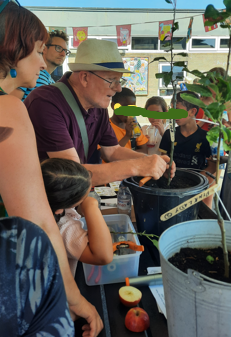
Pat O’Connor Grafting a Cripps Pink for Gladstone Park Primary School’s International Day on 11th July 2025.
In the International Day at GPPS, we grafted a bud from a Cripps Pink on to a semi-dwarf rootstock. The Town Team, donated this to the school, and they are gifting it to a primary school in Weliso, and then to my friend’s orchard. I will hopefully take it there in November .Who knows it may in years to come, be the genesis of an export trade in apples from Ethiopia.
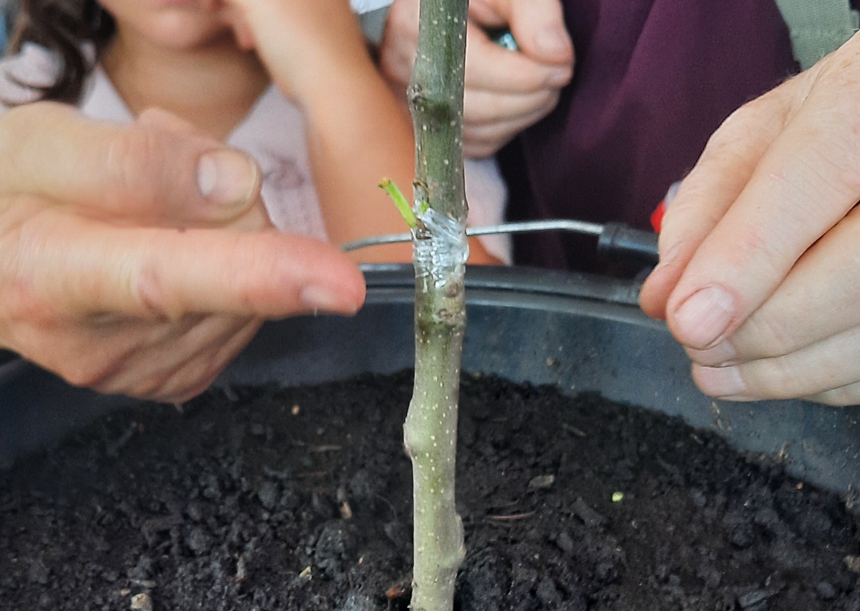
A new baby Cripps Pink, we hope!
Grafting as most procedures in the horticultural field, is an imprecise venture. I have done about 10 and may have a few for sale to raise funds for our gardening endeavour at the station. We receive zilch from TFL or the local authority, all is funded by our volunteers.
If any are available we will let you know next spring. As a footnote, the Cripps Pink will grow in Britain and produce fruit, but it probably will look more like a Granny Smith apple, it needs long hours of sunshine in the late growing season, to achieve that red/pink hue.
With ever increasing warmer summers, who knows.
Notes:
The best selling apple in Europe today is Pink Lady.
Pink lady, is a patented trade mark, subject to all sorts of copyright.
Commercial orchard, who wish to grow it have to sigh up to lots of conditions, only fruits of a minimum size can be sold etc.
There is no tree called Pink Lady, they are all grown on Cripps Pink.
There are no restrictions on growing and marketing Cripps Pink apples.
Patrick O’Connor
July 2025